03.28.2017
02:25 pm
Topics:
Amusing
Art
Tags:

Japanese nurse blowing through a conch shell
There’s a website called Sukima Nurse that offers pictures of a Japanese nurse holding unusual objects in a hospital and similar locales. The pictures fall generally into the stock photo category, although with a very, very narrow focus. It’s difficult to imagine anyone having any reason to use a picture of a Japanese nurse blowing through a conch shell, but that is the very thing that makes the pictures so hilarious.
In some of the pictures there is also a male patient looking at her or (sometimes) interacting with her.
It’s some millionaire’s kinky turn-on, right? It has to be.
Japanese nurse walking through hospital with a baseball bat and glove
Japanese nurse wearing too many wristwatches
Lots more after the jump…......
Posted by Martin Schneider
|
03.28.2017
02:25 pm
|
Leave a comment
03.28.2017
12:28 pm
Topics:
Music
Tags:
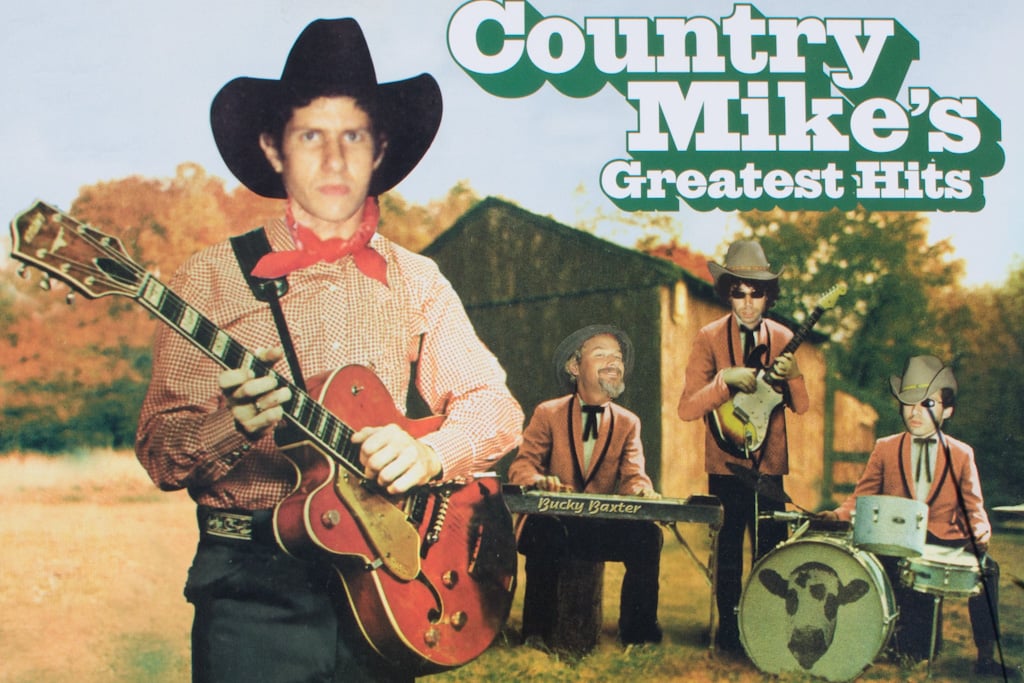
In the 1990s, from certain corners of the indie music landscape writ large, there cropped up a strange little genre we’ll just call “sh*tty country”: country music done without really the slightest attempt to carry it off properly, executed of course with a good dose of irony and, yes, condescension.
In 1996, for instance, Ween unexpectedly put out an album called 12 Golden Country Greats (which of course had 10 tracks on it). Ween went to the trouble of hiring a bunch of experienced Nashville session musicians to lay down the tracks, without ever telling them that the album was a bit of a put-on—my understanding is that the session guys got all pissed off when they heard the final product, which from the Ween fans’ perspective makes the whole escapade all the better. That album is both a put-on and an honest showcase of outstanding country musicianship.
Four years later, the Beastie Boys spent an afternoon in the studio (I’m guessing) and emerged with a Christmas present for a few hundred of their closest friends. For the recording it was necessary to create a quasi-fictional character known as “Country Mike,” a signal that Mike D. would be handling most of the vocals. The album was called Country Mike’s Greatest Hits, and it featured a baker’s dozen of half-assed and wildly entertaining country ditties.
Every recipient of the album also got this Christmas card
The initial pressing probably numbered about a thousand copies—if that many. Recipients received a Christmas card in a rustic style. Because of the private nature of the enterprise, scoring copies for regular fans has become difficult indeed. An original black vinyl pressing will run you $250 on Discogs, and the red vinyl pressing is available for $400. The situation at Amazon is similar. Fortunately, there’s an unofficial British release from last year which is priced in the same range as any other new LP.
More after the jump…
READ ON▸Posted by Martin Schneider
|
03.28.2017
12:28 pm
|
Leave a comment
03.28.2017
12:13 pm
Topics:
Pop Culture
Television
Tags:

Man, do I miss the The Mighty Boosh! We need their surreal weirdness back in our lives, please? Anyway, I discovered these magnificent Mighty Boosh nesting dolls by BoBo BaBushka. There are two sets of nesting dolls. The first one featuring Howard Moon, Naboo the Enigma, Rudi van DiSarzio, The Hitcher, and The Moon. See below:
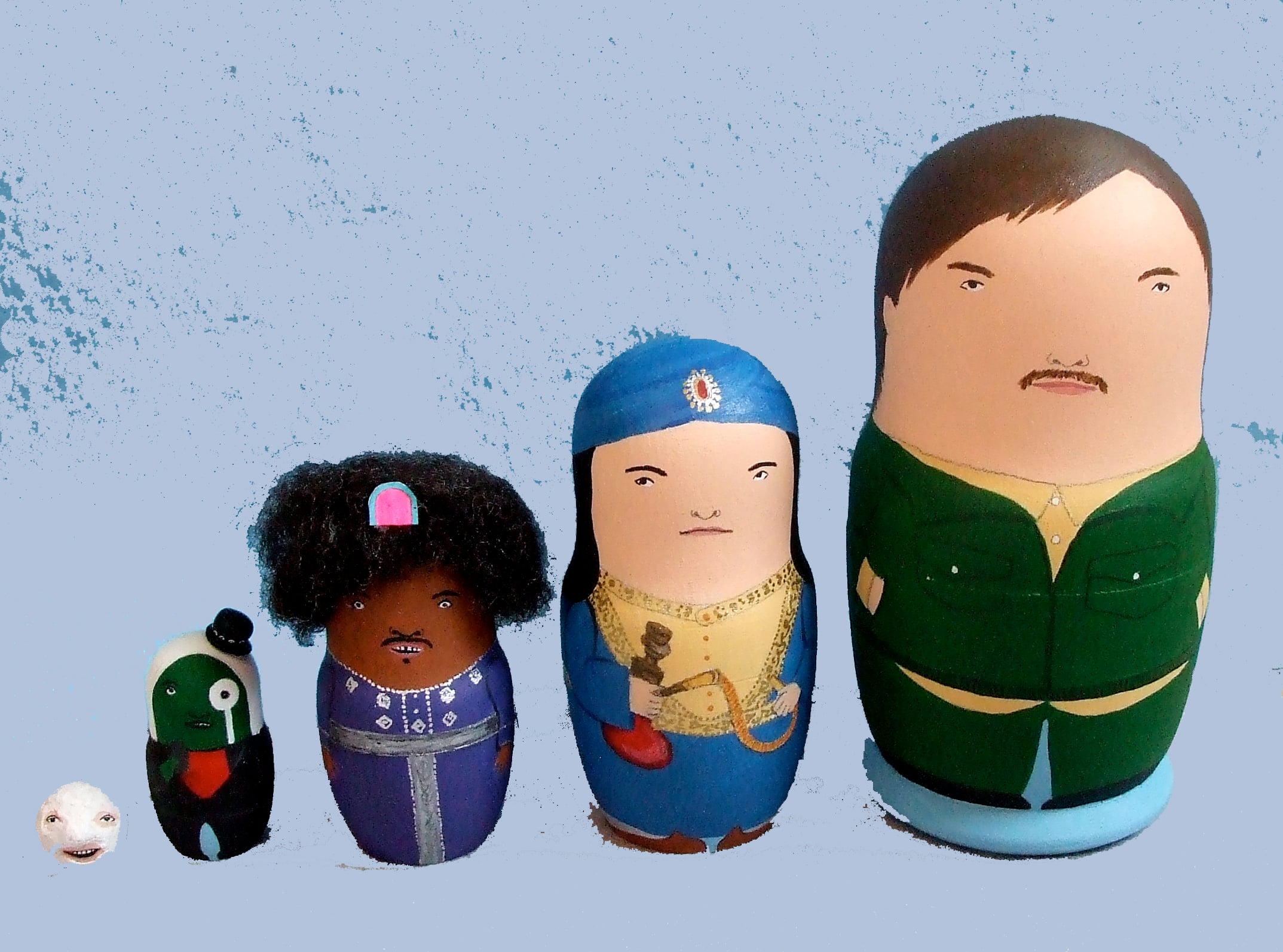
The second set features Vince Noir, Bollo, Old Gregg, The Spirit of Jazz and Tony Harrison. Where’s Bob Fossil???

These are totally adorable and right up my alley. Now as to whether or not these are for sale… I simply don’t know. Perhaps contact BoBo BaBushka to find out!
03.28.2017
10:07 am
Topics:
Art
History
Sex
Tags:

“Falling Stars” (1897).
Sometime in the mid-1870s, while living in Paris, the Hungarian artist Mihály Zichy produced a series of erotic illustrations. These pictures featured men and women having a right old time f*cking and wanking, sucking and licking. What inspired Zichy is unclear. A mid-life crisis? A raging hard-on? The current fashion for erotic illustration? Or perhaps wealthy patrons looking for some “dirty pictures”?
Most of these ink drawings lay undiscovered until after Zichy’s death in 1906. They were then collated together and a selection published in a book entitled Liebe (aka Oh, Liebe) in 1911. This nicely produced volume caused a bit of a stir. Zichy might have been pleased—he had often caused controversy with his work. His most famous picture was the demonically-charged anti-war painting “The Triumph of the Genius of Destruction” (1878). This painting was banned by the militaristic French authorities as deviant propaganda. He also managed to offend many Catholics with his work “Autodafé” (1868), which depicted the horrors of Spanish Inquisition. That said, Zichy was a very respectable artist. He painted the portrait of Lajos Batthyány, the first Hungarian Prime Minister. He was commissioned to produce paintings of the Empress of Austra, “Queen Elisabeth Laying Flowers by the Coffin of Ferenc Deák” and “Drinking Bout of Henry III.” He also supplied 27 illustrations for the poem The Knight in the Panther’s Skin in 1881.
Zichy was born in Zala, Hungary on October 15, 1827. He started out studying law before taking up a career as an artist. He traveled to Vienna where he became a pupil of the painter Ferdinand Georg Waldmüller. Under Waldmüller’s recommendation, he became a teacher. He then became a court artist for the Russian Tsar Alexander II. When he left St. Petersburg, he traveled around Europe before settling in Paris circa 1874.
Another intriguing question about Zichy’s erotic illustrations is whether he worked from life models? The drawings look more than just the work of some fevered imagination—most noticebly by the fact Zichy’s couples appear to be enjoying each other as equals and not portrayed as mere titillation for the male gaze. He also depicted gay sex and masturbation—which would have been shocking at the time. His style of drawing, the clear lines, the soft penciling, would influence succeeding artists producing similar erotic illustrations. 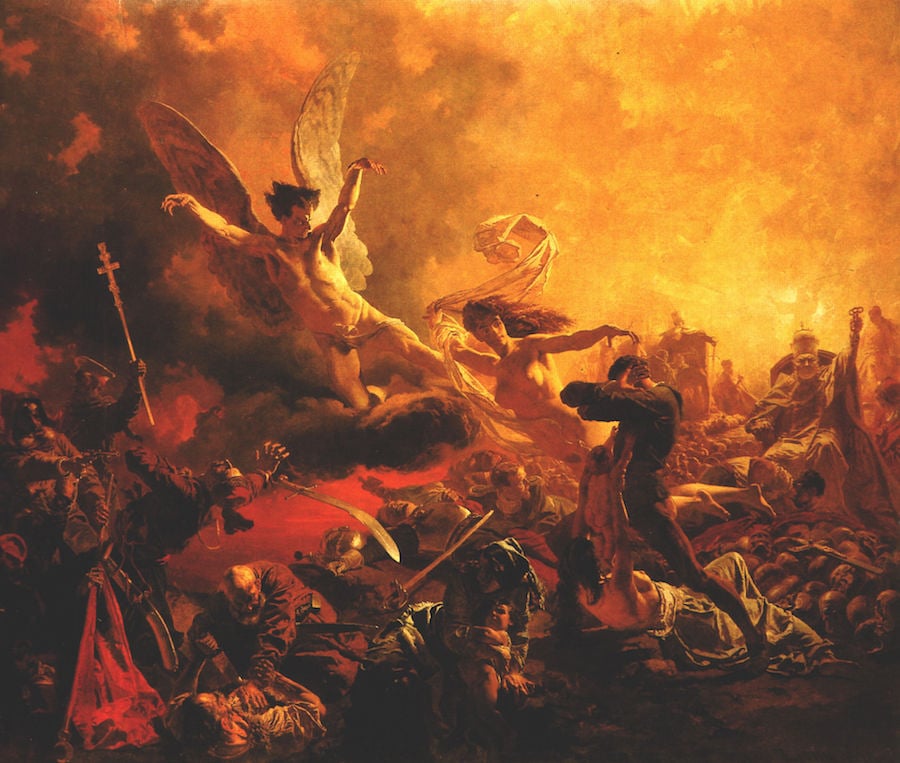
“The Triumph of the Genius of Destruction” (1878).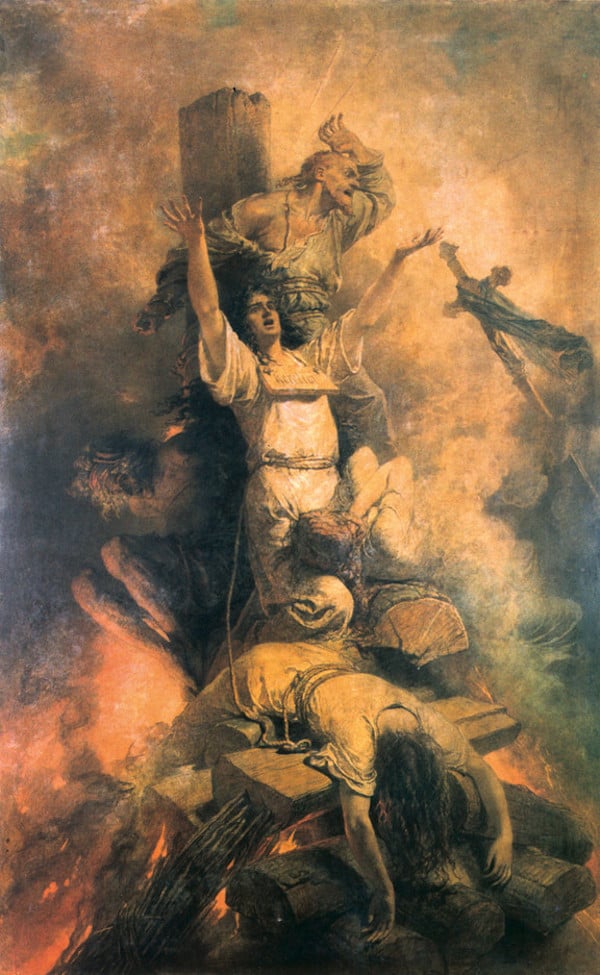
“Autodafé” (1868).
See more of Zichy’s erotic artwork, after the jump…
Posted by Paul Gallagher
|
03.28.2017
10:07 am
|
Leave a comment
03.28.2017
09:35 am
Topics:
Art
Sex
Tags:
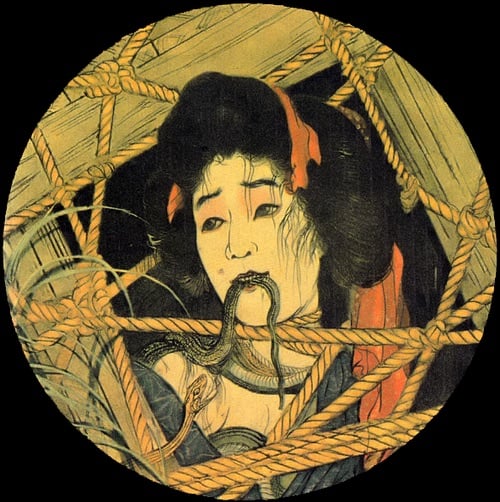
A painting by Seiu Ito depicting the art of erotic Japanese rope bondage, Kinbaku.
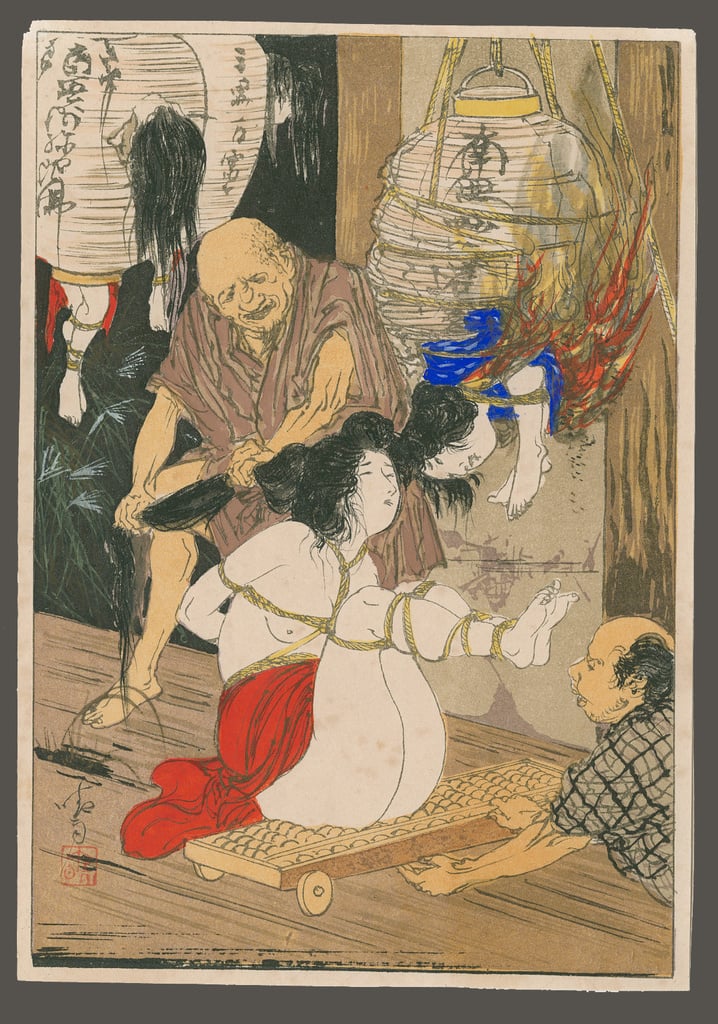
Tokyo-born artist Seiu Ito didn’t start his career as an artist by tying people up and painting or photographing the resulting scene, rather he excelled using other mediums to express himself such as metal, creating carvings out of ivory, painting and eventually sculpture. When he was thirteen Ito traded in his given first name of Hajime for Seiu. It was around that time that Ito started to draw images of women bound with rope known as the erotic Japanese art of Kinbaku or “tight binding.” Then, sometime in the early 1900s, perhaps 1907 when he was in his mid-20s, Ito took a job as an illustrator for a local newspaper and was quick to succeed as an in-demand artist for several different publications.
Prior to rope bondage becoming a form of erotic sex play, it was widely used during what is referred to as the last traditional period in Japan, the Edo Period (1603–1867) to bind and restrain criminals and other kinds of captives. And it was the erotic version of being tied up like an outlaw that made Ito a rich man. Although he was married several times during his life, that didn’t stop Ito from having affairs with other women, some who he kept as mistresses for long periods of time. Ito’s collection of women would become the primary subjects for his paintings and kinky photography which included erotic suspension. One of Ito’s more well-known and questionable images (and there are many) is of his then-pregnant wife (his second) Kise Sahara. Ito photographed and painted an image of a very pregnant, partially nude Sahara bound with rope, hanging from the ceiling by her feet.
Sadly by the time the 1930s arrived the Japanese government had long been busy banning artistic types and intellectuals as well as routinely censoring print media. Ito struggled to survive as an artist. Later his home and much of his work was destroyed in the Great Tokyo Air Raid. The work that survived the devastation helped solidify Ito’s dubious title as the “Father of Modern Kinbaku.” As you might imagine Ito’s work is the subject of several books as well as the 1977 film Beauty Exotic Dance: Torture! in which Ito plays himself to the hilt. Many of the photographs and paintings below are naturally NSFW. 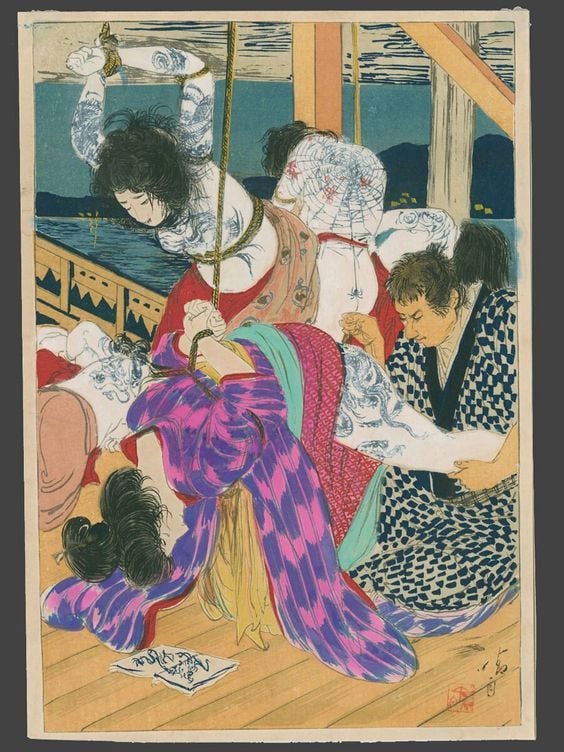
More after the jump…
Posted by Cherrybomb
|
03.28.2017
09:35 am
|
Leave a comment
03.28.2017
09:33 am
Topics:
Art
Drugs
Music
Tags:

“Power electronics” is not listener-friendly music on a good day. A cacophony of power drills, feedback, short-circuiting amplifiers, panicked screeching and walls of static, it’s f*cking useless to dance to and mostly makes sense to budding serial killers, adolescents who can’t figure out how to play guitars, and lonely dudes with severe social anxieties. Whitehouse were/are the reigning kings of the form, but other notable power electronics artists include Grunt, Atrox Morgue, Brighter Death Now and Genocide Organ. Bands in the genre generally self-release, cassettes and CD-Rs, mostly, sometimes in packages that will maim you when you try opening them. There is a very good book, Fight Your Own War: Power Electronics and Noise Culture, that explains the whole sordid power electronics story far better than I can. 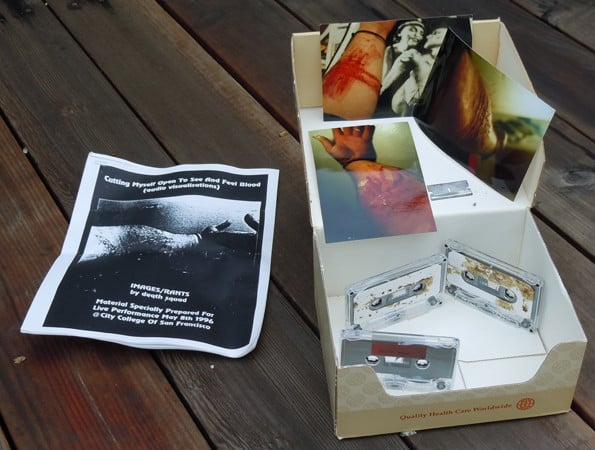
These tapes can give you hepatitis.
Anyway, west-coast noiseniks Death Squad already had a reputation for taking things beyond the pale. Even the description of his/their 1996 cassette release, Cutting Myself Open To See And Feel Blood, is enough to leave you whimpering in the corner:
“Contains individual photo, used razor blade and blood smeared tapes packaged in an Abbott OPD Reagant (hepatitis test kit!) box. Edition of 20 copies released at the “Blood And Self Mutilation” performance in City College Of San Francisco May 8th 1996.”
But in 1999, the one-man noise unit performed at a club called Lab in San Francisco, and it just might be the most over-the-top “musical” performance of all time, power electronics, GG Allin or otherwise. The wordy flyers for the gig did have a few red flags—they prominently featured a gun, a syringe and razor blade, and the text-dense manifesto included lines like “Small measures of terrorism are the only hope for the collapse of your perception and constantly programmed ideologies.” So, you know, it wasn’t gonna be an easy ride anyway. But the fifty or so aggro-music enthusiasts in attendance definitely got a lil’ more than they bargained for. Forget the wall of screeching, blood-curdling noise that ripped away at the speakers, that much was a given. It was the crazy sh*t going down onstage that really put it over the top. 
Original flyer for the notorious performance
The show opened in typical 90s industrial/noise fashion, with Death Squad main man Michael Nine seated at a desk, illuminated only by a small lamp. Behind him, a film screen projected the usual edge-wizard atrocities: animal abuse, “true gore” clips, the whole life-is-horror trip. So far, another ho-hum night in 1999. And then things went over the rails.
Ximena Quiroz was in the audience that evening and posted her experience on a Yahoo Forum for fans of Einstürzende Neubauten shortly after the show:
“The desk [Nine] was sitting at had a syringe, razors, a little cup with some sort of liquid in it, a box of bullets, and a gun. The gun and the bullets were real. During the video, he proceeded to inject himself with something (heroin, maybe?). Then he took the razor and began to saw his arms with it until he was bleeding profusely. At first, I thought he wasn’t really cutting himself, but he wouldn’t stop bleeding, even when he wasn’t cutting himself.”
Okay, so far we’ve got heroin use and self-mutilation. And the dude is only getting started. At this point, it’s probably time to pack up and go home. Half the audience did, in fact. But Ximena stuck around, and things quickly escalated.
More after the jump…
READ ON▸Posted by Ken McIntyre
|
03.28.2017
09:33 am
|
Leave a comment
03.27.2017
02:43 pm
Topics:
Food
Movies
Tags:
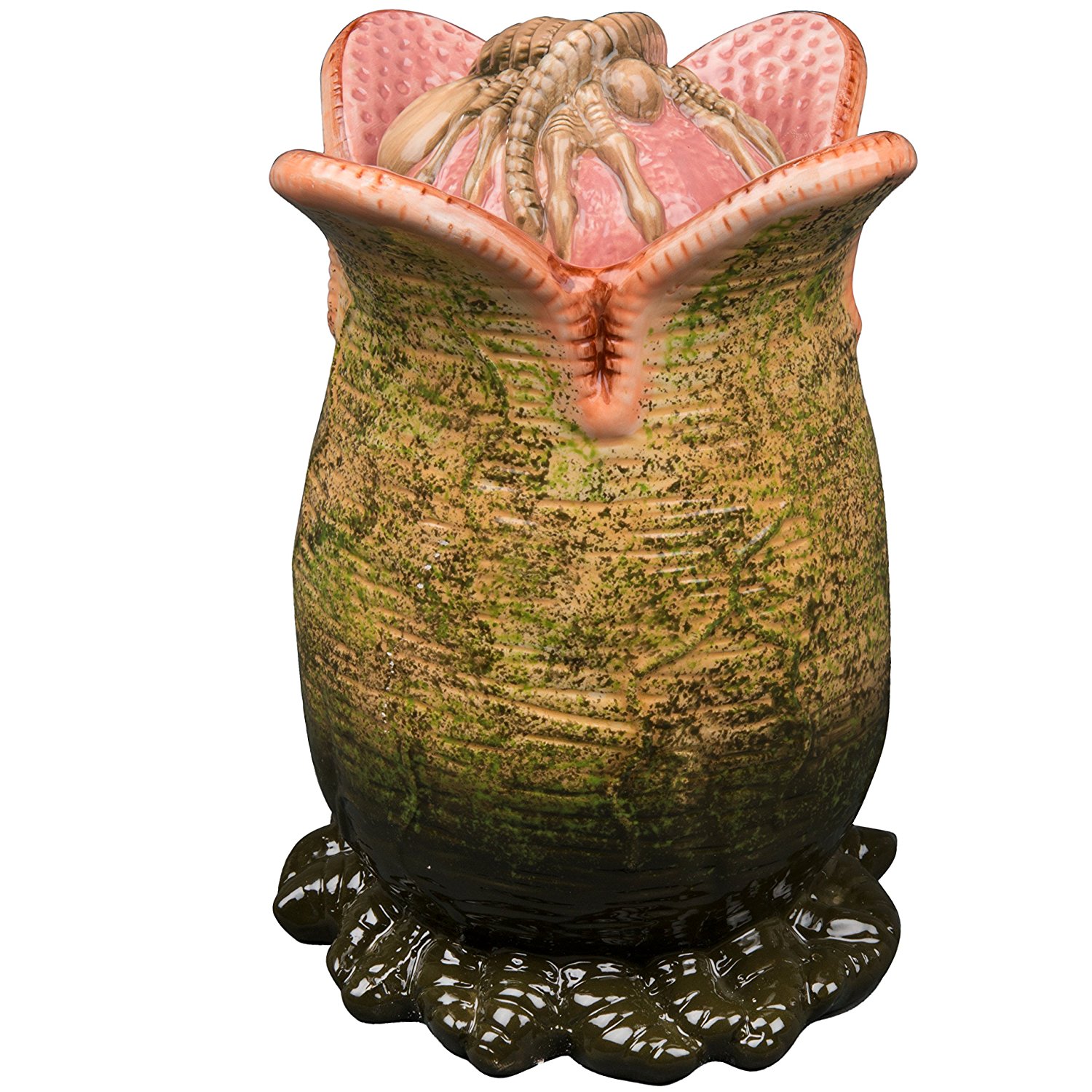
Check out this fantastic-looking ceramic Alien cookie jar with a “facehugger” lid. If you’re a fan of the Alien franchise, this has got to be the perfect cookie jar for you. I do not own one (yet) but the ratings so far are all five stars.
Description from the listing:
- Highly detailed Xenomorph egg design from the Alien film franchise
- Facehugger lid to keep cookies fresh
- Ceramic cookie jar and lid measure 9” by 5.5”
- Not dishwasher safe, wash by hand only
- In space no one can hear you take the last cookie!
Either you’re going to eat more cookies or fewer depending on how comfortable you are pulling a cookie out of an alien Xenomorph egg. The egg cookie jar sells for $29.95 here.



Thanks to Kevin K!
Posted by Tara McGinley
|
03.27.2017
02:43 pm
|
Leave a comment
03.27.2017
02:32 pm
Topics:
Games
History
Tags:
A few years ago, I was living in New York City but had struck up some friendships in Cleveland, where I would eventually relocate. I had heard about this funny game Cards Against Humanity and it had struck my fancy, so I plunked down 25 bucks in some virtual kiosk and got myself a set. At a New Year’s Party in Cleveland a few months later, I unveiled it to the assembled revelers, and it rapidly became the dominant activity of the party. A few months later, and it was hard to find a party where it did not get mentioned as a possible activity.
Cards Against Humanity, the self-styled “party game for horrible people,” was the brainchild of multiple people, one of the most prominent of whom was Max Temkin, who has now teamed up with video game producers Mike Boxleiter and Tommy Maranges to find out if they could create a “social deduction” board game with the addictiveness of CAH.
My money says that they have.
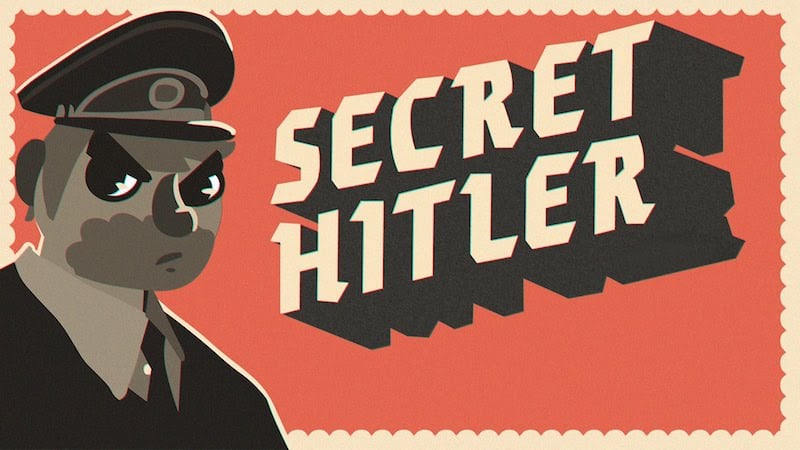
The subject of an attention-getting Kickstarter that amassed nearly $1.5 million, Secret Hitler became available to consumers around the time of Donald Trump’s inauguration, which certainly speaks to impeccable timing on the part of Goat, Wolf, and Cabbage LLC, the company that is distributing the game. The game made a minor splash in late February when they shipped a free copy to all 100 U.S. Senators, thereby making explicit whatever metaphorical connections to the daily headlines may have been buzzing around your brain.
As with Cards Against Humanity, the people behind Secret Hitler have taken a staunchly populist and what might be termed anti-corporate approach—and the two games are united by a similar sense of cheeky humor. In both cases users have been encouraged to print up their own sets of the game for free, if they so choose. Here’s the GitHub online implementation of the game. To celebrate Black Friday in 2014, the CAH people invited people to send them six bucks in exchange for “Bullsh*t,” which is exactly what they ended up receiving. 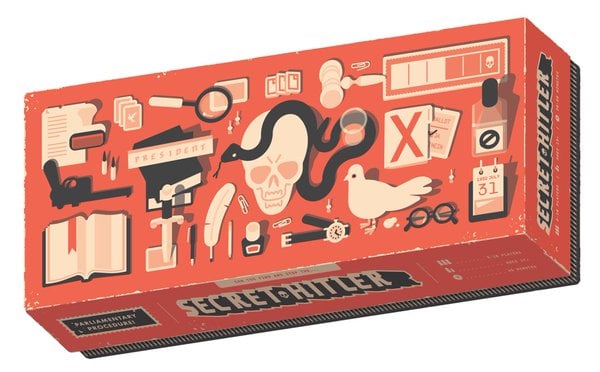
In the game, it’s Germany 1932, and the Liberals are pitted against the Fascists (one of whom is Hitler). The Fascists know which players are Fascists (and by extension, which players are Liberals), but the Liberals don’t know what side any of the other players is on. Gameplay varies according to the number of players (5-10), but in most versions Hitler does not know who his (or her) supporters are.
Every game begins with a clever ritual in which all players close their eyes, and then, on a given cue, Fascists open their eyes and ID one another. The game comes with an app in which a recorded message by Wil Wheaton guides you through the process.
The game proceeds by repeatedly naming a President who must select a Chancellor, the two of whom then must collaborate to place Liberal or Fascist policies on the board. Both sides have two paths to victory: if the Liberals place 5 policies on the board, they win, and the same is true of the Fascists, except they need 6 policies. The Liberals can win by assassinating Hitler, and the Fascists can win if they manage to get Hitler elected Chancellor after sufficient information about the players’ identities has been distributed (that is, after three Fascist policies have made it onto the board).
Basically, at every point in the game, all players will be claiming to be Liberals; the trick is to track game moves to figure out who is actively pushing Fascist policies and who has been forced by circ*mstance to promote them against their will.
More after the jump…
Posted by Martin Schneider
|
03.27.2017
02:32 pm
|
Leave a comment
03.27.2017
10:31 am
Topics:
Books
Design
Movies
Tags:

Thankfully Raymond Chandler was a lousy poet.
Chandler started writing after he was fired from his job with the Dabney Oil Syndicate. He was vice president of the company. Made no difference. He was fired after spending too many days sitting in his swivel chair, foot-dangling, fooling around with his secretary and getting loaded. His alcoholism and absenteeism led to his dismissal. It was 1932. America was in a deep depression. Chandler was in his mid-forties. He had no money, no prospects, a worrying taste for liquor and an invalid wife to support. Chandler later said, there is nothing like losing your money to find out who your friends really are.
Chandler found out he had none.
That was when he made his most radical, most insane, and most important decision of his life. He decided to become a writer.
Chandler had picked up on the Black Mask detective fiction magazine. He read it and thought maybe he could write pulp fiction too. Chandler had once wanted to be a poet. It took him time but he eventually realized he was a poor poet. His poesy had too much verbiage, too much thinking and not enough doing. How different things could have been for 20th century American literature had Raymond Chandler stuck to writing verse.
Chandler decided he had better learn how to write. He signed up for classes in short story writing. He got an “A.” He studied Erle Stanley Garner by copying out his stories to learn how they were constructed. He read Dashiell Hammett. He read Hemingway. He wrote pastiches of them all.
Hemingway, Hammett, and Garner taught Chandler how to cut the slack in his writing. He later claimed it took him two years to learn how to have a character leave a room or take his hat off. Simple writing, he discovered, was exceedingly difficult. His experiences writing short detective fiction for Black Mask taught Chandler everything.
After five years with Black Mask, Chandler wanted to move on. He knew his short stories were just thumbnail sketches for a much greater work. In the summer of 1938, Chandler spent five months writing The Big Sleep. It was the first of seven novels featuring his hardboiled private eye Philip Marlowe.
Marlowe was a composite of all the other private detectives Chandler had written. He plundered his back catalog lifting plots and storylines from his Black Mask stories. The Big Sleep used plot lines from earlier stories like “Killer in the Rain” (1935) and “The Curtain” (1936). Chandler was more interested in creating atmosphere than just writing plots. His novels were not whodunnits? but rather “whydunnits?” How Marlowe responded to each story was as important as solving the crime. Everything was refracted through Marlowe. It was a new way of writing detective fiction, one that changed everything—and one that would inevitably lead to the Gonzo writing of Hunter S. Thompson where the narrator is as important as the story he is telling.
I dug Chandler from the day I pulled The Lady in the Lake off the library shelf. Chandler hipped me to a world of action and a style of writing that changed my life. I eventually bought up all the Marlowe stories I could afford. Then through time and foolishness, lost them all again. Before Christmas last year, I picked up a boxed set of the complete Philip Marlowe novels. They were the same set of green-spined Penguins I had first started reading way back when I thought these the coolest books I had ever seen. Designed by James Tormey, the covers used colorized stills from original 1940’s Marlowe movies featuring Humphrey Bogart, Lauren Bacall, Robert Montgomery, and Dick Powell.
About a decade ago, I snapped up another set of Penguin Marlowes, this time with iconic, minimalist covers by Steven Marking. Both sets of covers are cool but the contents will always be best.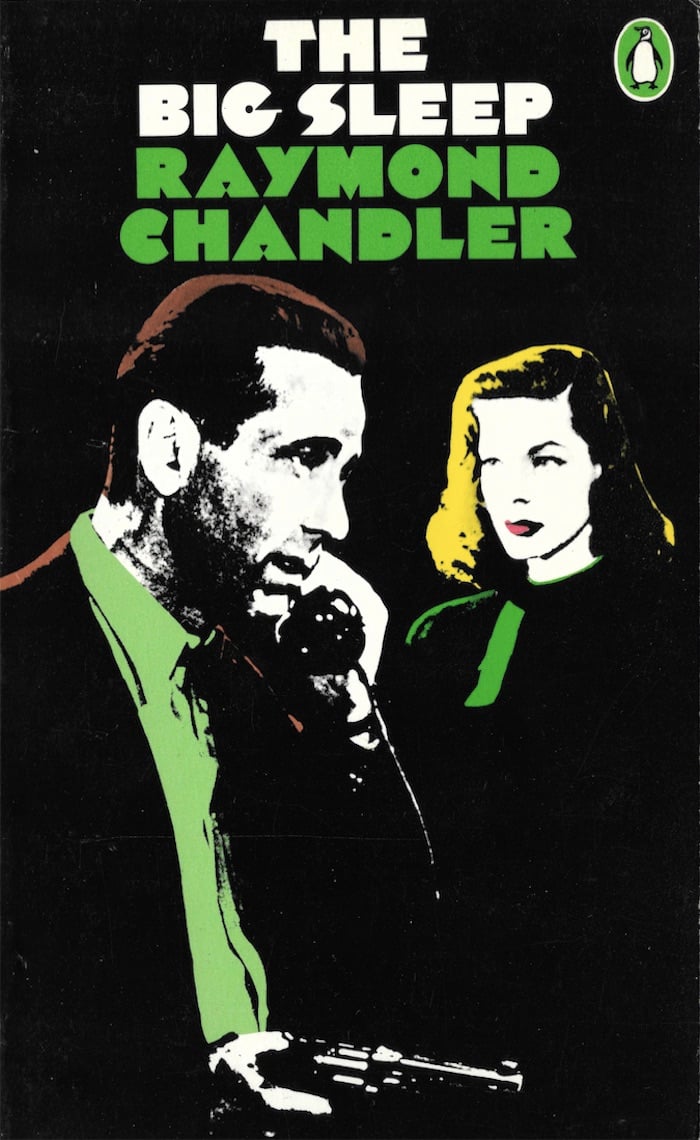
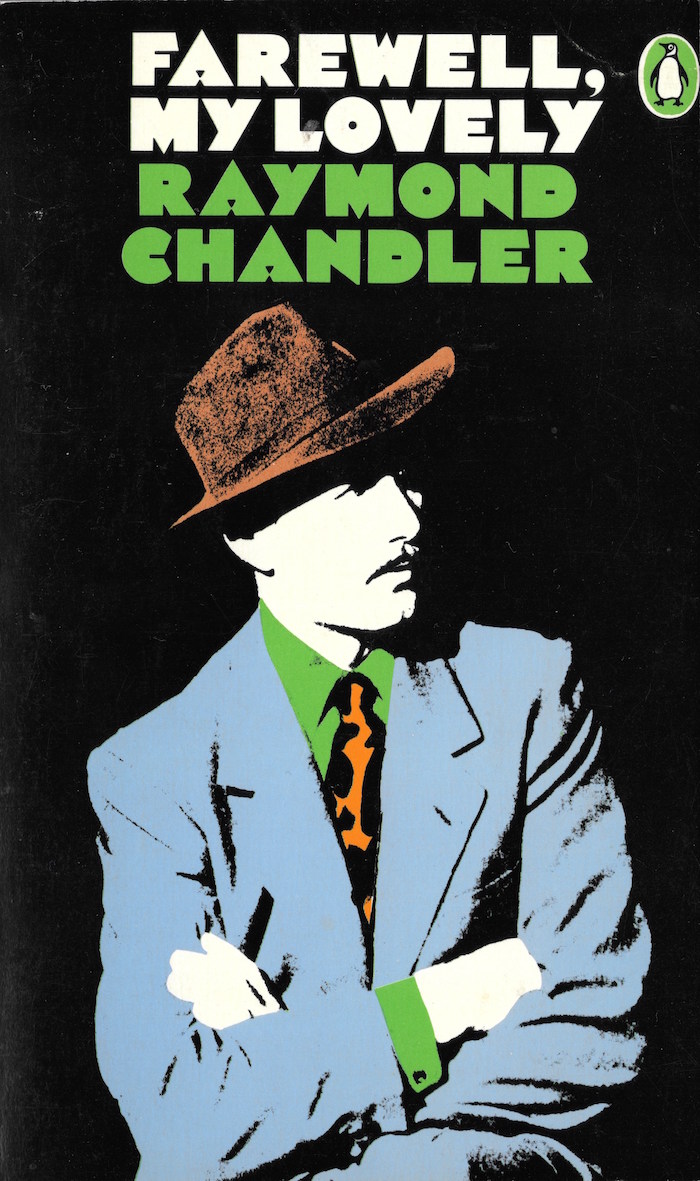
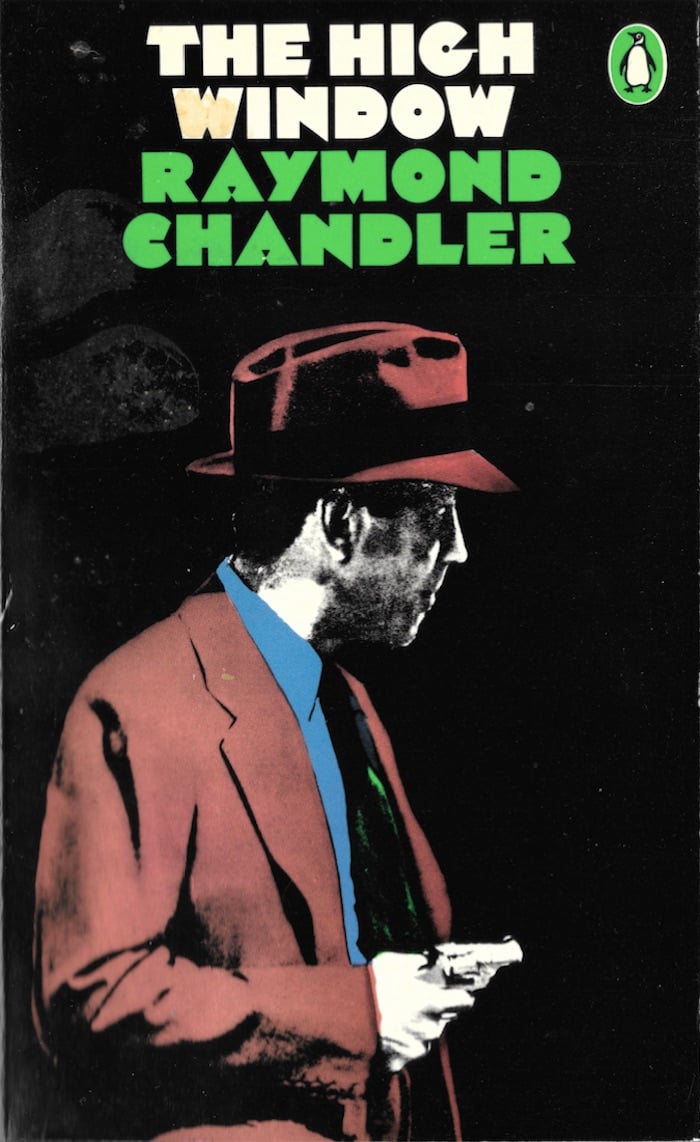
See more classic Raymond Chandler covers, after the jump…
Posted by Paul Gallagher
|
03.27.2017
10:31 am
|
Leave a comment
03.27.2017
10:21 am
Topics:
Games
Music
Punk
Tags:
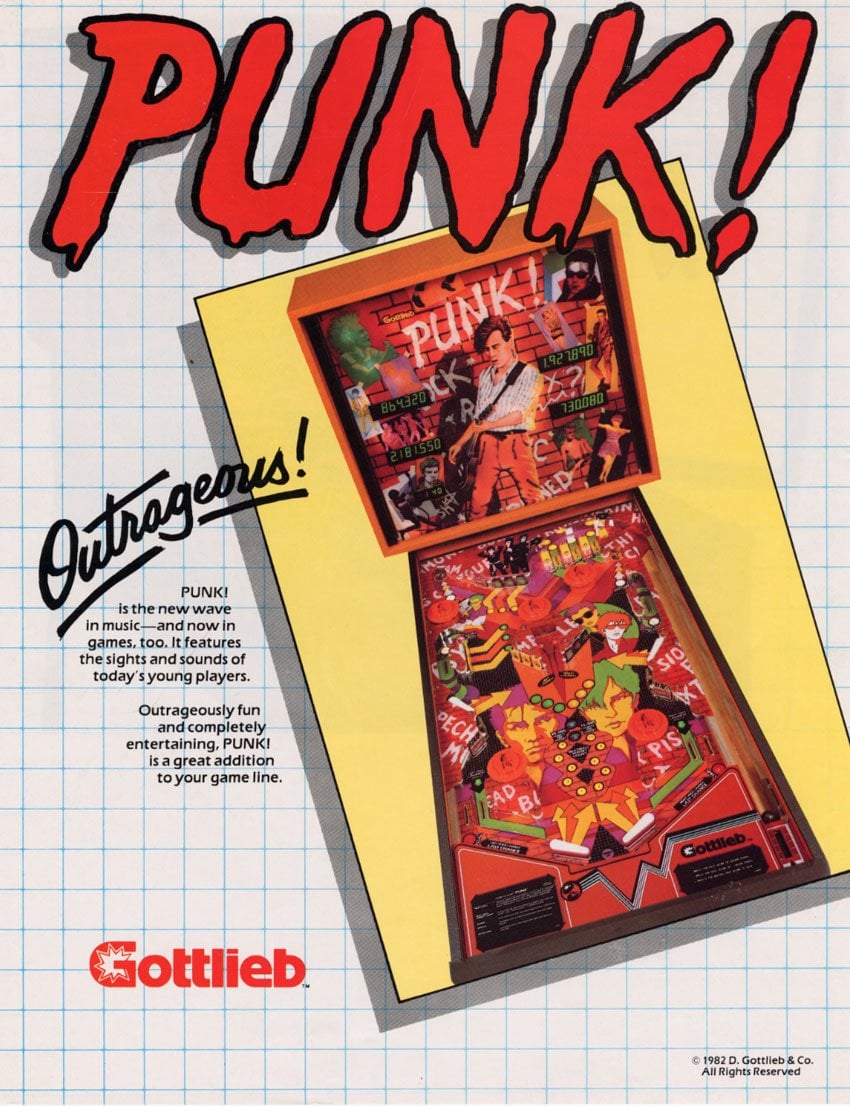
I’ve never liked arcade video games much, but I’ve always been really into pinball machines. So much so that in the last few years I’ve joined a local pinball league (great fun!) and visited a few pinball conventions. I’ve even driven way out of my way to visit specific coffee shops and pizzerias just because some model I hadn’t played before was available to use.
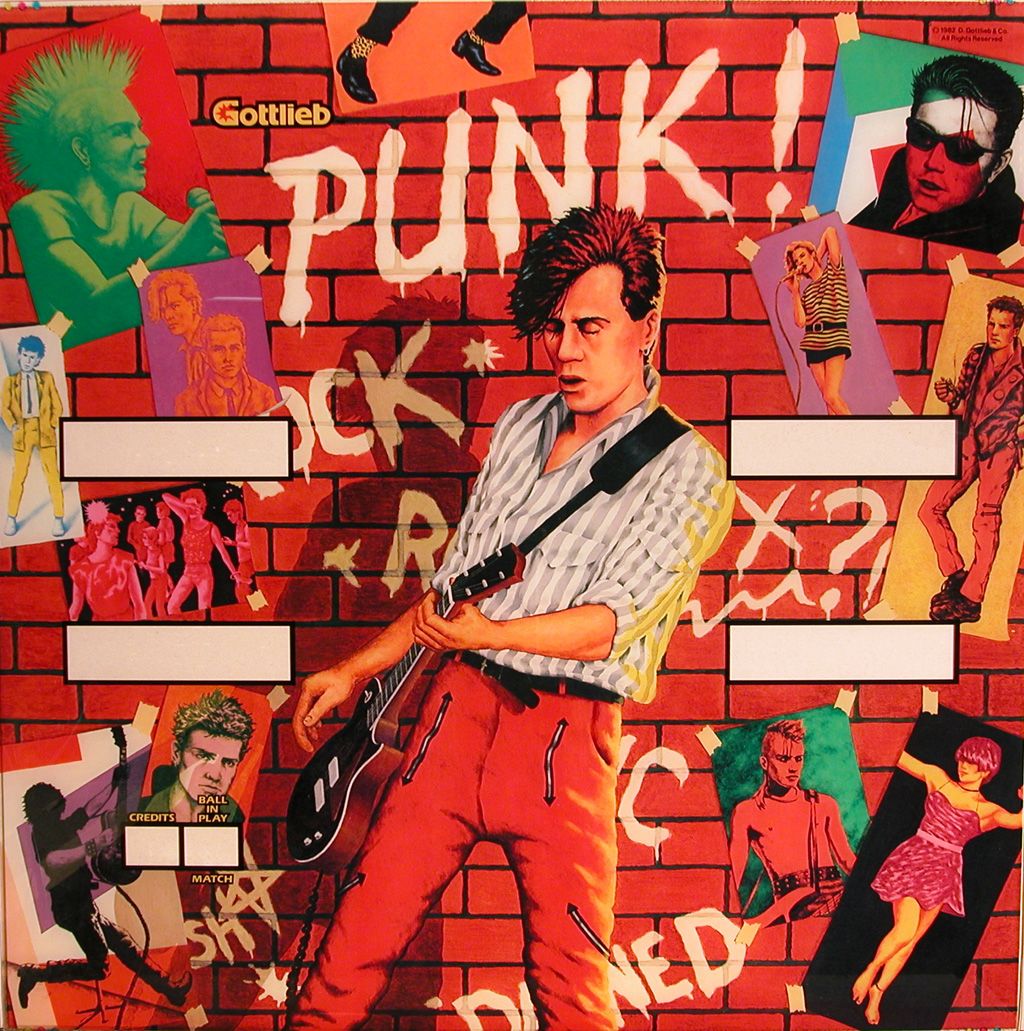
So over the weekend I come across an amazing image of a “Punk!” pinball machine from D. Gottlieb & Company, universally known as “Gottlieb,” that dates from the year 1982. I’ve never even seen an image of this game before, much less played it. Every DM reader is aware of the cross-pollination involved between punk and new wave, there’s a lot to be said on that subject, and yet….. there’s something off about this game.
It’s amusing to see how some of the major punk acts are “implied” in a non-licensed way by having scrawled graffiti with certain letters blocked out so that nobody could really say which band starting with “S-I-O” is being referenced.
So you can spot Siouxsie Sioux being invoked on the right-hand side; at the bottom you have “EAD BO” which is surely the Dead Boys. At the top you’ve got the Ramones and the Jam and the Clash being signaled. Interesting to see Joy Division tucked away up there as well. On the backglass, behind the guitarist’s left leg, you have what appears to be the word “DAMNED” partially blocked, all the more enticing to a teen demographic because it involves a curse word.
But wait—what’s that on the left-hand side there? “PECH—M—”? How did Depeche Mode get involved with this?? They are definitely not punk!
Remember, 1981 was the high point of the synth-pop movement, with Soft Cell, Ultravox, and OMD all in their prime. This machine may say “Punk!” on it but it mainly has me thinking of Square Pegs and Valley Girl.
On this Pinside forum there’s a lively discussion about the game—not surprisingly, Punk! is a very difficult game to find from a collector’s perspective. One observer comments that “it is among the most difficult and nearly impossible pins to aquire.” Fewer than 1,000 were made, and even though the gameplay does not look all that interesting, it’s such a great item to have around that people who have it probably seldom let it go.
Price estimates run around $800, which is a fairly ordinary price for a machine of this type. Given its rarity, if the gameplay were actually engaging the sky would be the limit here!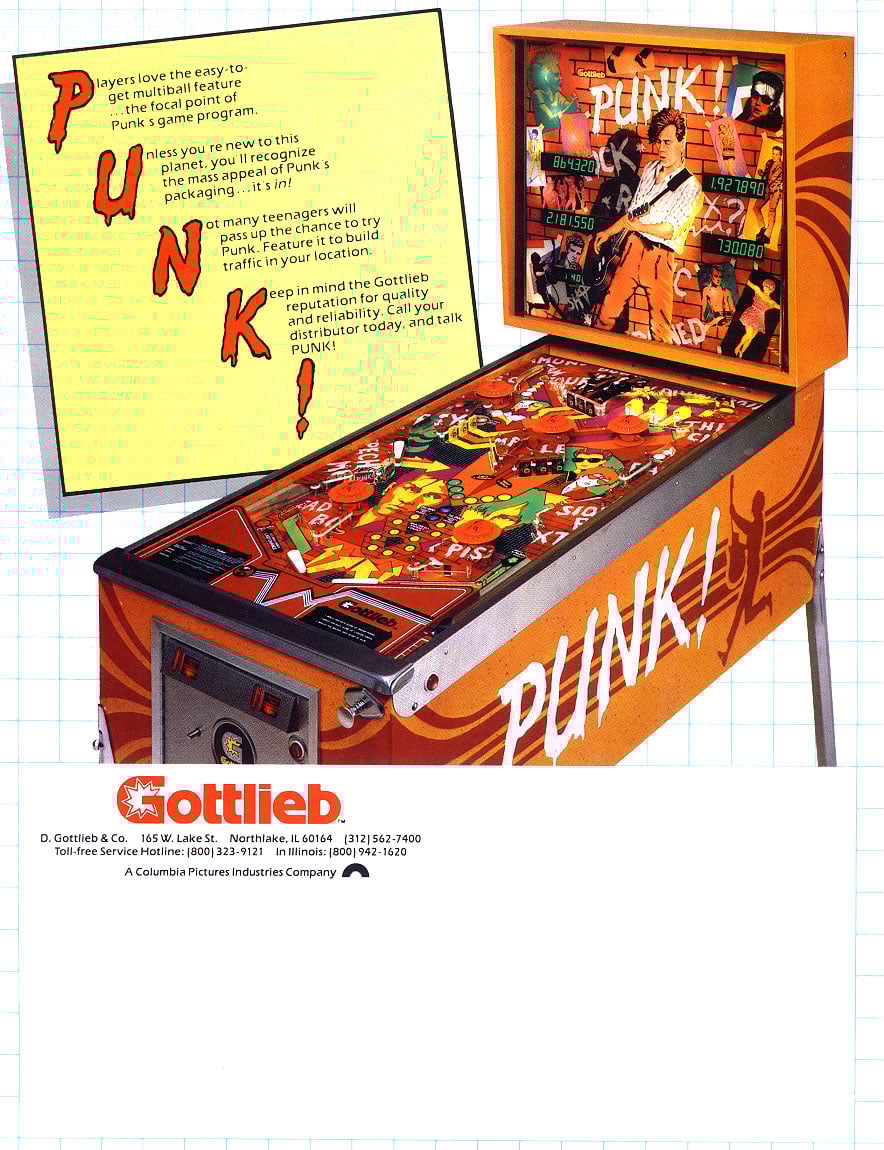
More after the jump…
Posted by Martin Schneider
|
03.27.2017
10:21 am
|
Leave a comment
Page 217 of 2347 ‹ First<215216217218219>Last ›
